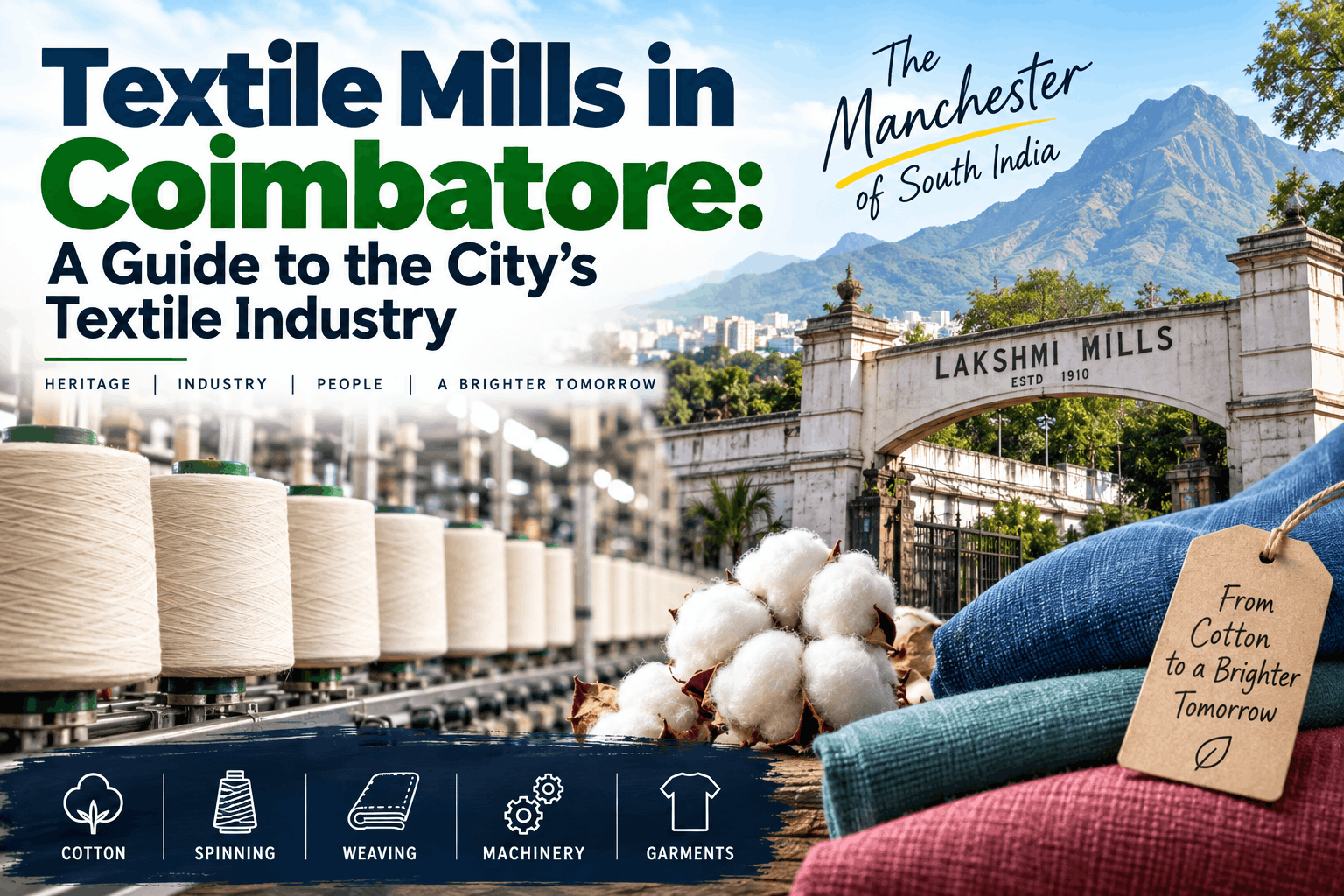
Textile Mills in Coimbatore: A Guide to the City's Textile Industry
From historic cotton mills and spinning factories to textile machinery, research institutions and modern manufacturing, discover how textiles helped shape Coimbatore's industrial identity.
🧵 Coimbatore Textile Industry at a Glance
| Known As | Manchester of South India |
| First Textile Mill | 1888 |
| Major Strengths | Cotton, spinning, yarn, textile machinery and engineering |
| Major Nearby Textile Hub | Tiruppur |
| Supporting Ecosystem | Engineering, research, testing, logistics, education and exports |
When people talk about Coimbatore, textiles are among the first industries that come to mind. The city has a long association with cotton, spinning, weaving, textile machinery and garment manufacturing, earning it the familiar nickname “Manchester of South India.”
But Coimbatore's textile story is much bigger than a collection of spinning mills. From early cotton ginning and spinning operations to large textile companies, modern yarn manufacturers, machinery producers and research institutions, the industry has helped shape the city's economy and industrial culture.
Today, Coimbatore remains an important textile manufacturing centre while neighbouring Tiruppur has become internationally recognised for knitwear and garment exports.
Why Is Coimbatore Famous for Textiles?
Coimbatore's textile growth was closely connected with cotton cultivation, entrepreneurship, electricity, engineering capabilities and geographical location.
The Coimbatore district administration states that successful cotton cultivation provided the foundation for the textile industry and that the first textile mill in the city was established in 1888.
The development of hydroelectric power, particularly the availability of power from the Pykara hydroelectric project during the 1930s, further accelerated industrial development.
🔄 The Textile Value Chain
↓
Ginning
↓
Spinning
↓
Yarn
↓
Weaving / Knitting
↓
Processing
↓
Garments & Home Textiles
↓
Export & Retail
A Brief History of Coimbatore's Textile Industry
Coimbatore's textile history stretches back well over a century. During the late 19th century, cotton cleaning and pressing operations were already developing in the region.
The first textile mill in Coimbatore was established.
Ginning activity associated with Lakshmi Mills began in the region.
Lakshmi Mills was established.
Hydroelectric development supported rapid industrial expansion.

Historic Lakshmi Mills Northern Gate, Coimbatore. Image courtesy: Wikimedia Commons. Please retain the applicable author and licence attribution from the original file page.
What Does a Textile Mill in Coimbatore Actually Do?
The phrase “textile mill” can refer to several different types of manufacturing facilities. A traditional cotton textile operation may include some or all of the following stages.
Ginning separates cotton fibre from cotton seeds and prepares the fibre for subsequent processing.
Raw cotton is opened, cleaned and blended before entering the spinning process.
Fibres are separated, cleaned and aligned to produce a more uniform fibre web.
Short fibres are removed and the remaining fibres are further aligned for finer yarn production.
Fibre strands are combined and drafted to improve uniformity.
Prepared fibres are converted into yarn using technologies such as ring spinning, compact spinning, rotor spinning and air-jet spinning.
Yarn is converted into fabric through weaving or knitting.
Depending on the product, fabric may undergo dyeing, bleaching, printing and finishing.
The finished material can become garments, towels, bedsheets, industrial textiles and many other products.
Major Textile Mills and Companies Associated with Coimbatore
Lakshmi Mills
Lakshmi Mills is one of the most recognisable names in Coimbatore's textile history. Established in 1910, the company developed from the region's cotton and ginning ecosystem into a major textile manufacturer.
Its historic presence on Avinashi Road has also made Lakshmi Mills a familiar landmark for generations of Coimbatore residents.
Varadaraja Textiles
Varadaraja Textiles is another textile-mill name associated with Coimbatore. Wikimedia Commons contains photographs identifying the facility as a cotton spinning mill in the city.
.JPG)
Varadaraja Textiles, Coimbatore. Image courtesy: Wikimedia Commons. Photograph by Ask27, licensed under CC BY-SA 4.0.
Radhakrishna Mills
Radhakrishna Mills is another historic textile-mill name documented in Wikimedia Commons' category dedicated to textile mills in Coimbatore.
Historical references to textile companies should not automatically be interpreted as confirmation that a particular mill is currently operating at the same location or under the same ownership. Verify current status directly before using this information for employment, procurement or business purposes.
Other Textile Names Connected With Coimbatore
- Premier Mills
- KPR Mills
- Bannari Amman Spinning Mills
- Shiva Texyarn
- Kadri Mills
- Varadaraja Textiles
- Lakshmi Mills
- Various National Textile Corporation mill units
Coimbatore's Textile Industry Is Bigger Than Its Mills
One of the most interesting aspects of Coimbatore's industrial development is that the city did not simply develop textile mills. It developed an entire supporting ecosystem around them.
Textile Machinery
Engineering
Testing & Research
Logistics
Education
Exports
As textile production expanded, mills created demand for spinning machinery, motors, pumps, bearings, electrical equipment, automation systems, maintenance services and engineering workshops.
This relationship between textiles and engineering became one of the defining characteristics of Coimbatore's industrial economy.
Textile Research and Technology in Coimbatore
Coimbatore's textile ecosystem is also supported by research and educational institutions. Organisations associated with the city's textile sector include:
- South India Textile Research Association (SITRA)
- Sardar Vallabhbhai Patel International School of Textiles and Management
- Central Institute for Cotton Research – Southern Regional Station
Together, research, testing and education help connect traditional textile manufacturing with new production technologies and technical skills.
Coimbatore and the Wider Textile Region
Coimbatore's textile industry should be viewed as part of a wider regional manufacturing network.
| Location | Strongly Associated With |
|---|---|
| Coimbatore | Spinning, yarn, textile machinery, engineering and research |
| Tiruppur | Knitwear, garments and apparel exports |
| Erode | Textiles, yarn, fabric and wholesale textile trading |
Why Is Coimbatore Called the "Manchester of South India"?
The nickname reflects Coimbatore's long history and concentration of cotton and textile manufacturing.
- Strong cotton-growing region
- Large spinning and textile industry
- Long history of industrial entrepreneurship
- Strong engineering and machinery ecosystem
- Skilled industrial workforce
- Established research and educational institutions
- Close links with Tiruppur and Erode textile clusters
How Many Textile Mills Are There in Coimbatore?
There is no single reliable number that should be used as a permanent count of textile mills in Coimbatore.
The term textile mill can include spinning mills, composite mills, weaving facilities and other textile manufacturing units. The industry also changes continuously as companies expand, modernise, consolidate or discontinue individual facilities.
Instead of focusing only on the number of mills, consider Coimbatore's complete ecosystem of textile manufacturers, spinning units, machinery companies, engineering suppliers, research organisations and downstream industries.
Textile Jobs and Employment in Coimbatore
The textile industry has historically been an important source of employment in Coimbatore and neighbouring districts.
How Technology Is Changing Coimbatore's Textile Mills
The traditional image of a textile mill—rows of machines producing yarn continuously—is increasingly being replaced by highly automated and data-driven manufacturing systems.
Modern Textile Manufacturing Focus
Sustainability: The Next Chapter for Textile Mills
Textile manufacturing can consume substantial energy and, depending on the process, water and chemicals. Sustainability is therefore becoming an increasingly important part of modern textile production.
- Energy-efficient machinery
- Renewable energy
- Water recycling
- Waste reduction
- Improved effluent treatment
- Recycled fibres
- Sustainable yarns
- Cleaner production processes
🧠 Did You Know?
- Coimbatore's first textile mill dates back to 1888.
- Cotton cultivation played a major role in establishing the textile industry.
- Hydroelectric power helped accelerate industrial development during the 20th century.
- Textile manufacturing contributed to the growth of Coimbatore's engineering sector.
- Coimbatore and Tiruppur have complementary roles within the regional textile economy.
📣 Your Coimbatore Textile Memory
Coimbatore's textile industry is not just an economic story—it is part of the city's everyday history.
Do you remember a textile mill, factory or industrial landmark from your childhood?
- Which mill or textile company do you remember?
- Was it located near your neighbourhood?
- Did a family member work in the textile industry?
- Do you have an old photograph of a Coimbatore textile mill?
Share your memories in the comments. Local stories and old photographs can help preserve Coimbatore's industrial heritage for future generations.
Frequently Asked Questions
Coimbatore is widely known as the Manchester of South India because of its long association with cotton and textile manufacturing.
When did the textile industry begin in Coimbatore?The Coimbatore district administration states that the first textile mill was established in 1888.
What is Coimbatore famous for in textiles?Coimbatore is particularly known for cotton spinning, yarn manufacturing, textile mills, textile machinery and supporting engineering industries.
Is Coimbatore still an important textile centre?Yes. Coimbatore continues to have a significant textile manufacturing base supported by research institutions, engineering companies and textile machinery manufacturers.
What is the difference between Coimbatore and Tiruppur's textile industries?Coimbatore is particularly associated with spinning, yarn, textile machinery and engineering, while Tiruppur is internationally recognised for knitwear and garment manufacturing.
Can visitors tour textile mills in Coimbatore?Most operating textile mills are industrial facilities and are not open for casual public tours. Anyone interested in visiting should contact the individual company and obtain permission beforehand.
The Future of Coimbatore's Textile Industry
Coimbatore's textile industry has already passed through several major transformations—from cotton ginning and early spinning mills to mechanised production, sophisticated machinery and increasingly automated manufacturing.
Tamil Nadu's textile policy direction increasingly emphasises the complete value chain, from fibre and yarn to technical textiles, processing, garmenting, machinery and home textiles.
Conclusion
The story of textile mills in Coimbatore is ultimately the story of how a regional cotton economy evolved into one of South India's most important industrial ecosystems.
Cotton created the opportunity. Mills created large-scale manufacturing. Electricity accelerated growth. Engineering supported the machines. Research improved the technology. Generations of workers and entrepreneurs built the industry into what it is today.
Coimbatore may have changed dramatically over the past century—but textiles remain an important part of the city's industrial identity.
📷 Image Courtesy & Sources
Historical textile-mill photographs used in this article are sourced from Wikimedia Commons. Individual image licences and attribution requirements should be checked on the original file pages before publication.
- Lakshmi Mills Northern Gate – Wikimedia Commons
- Varadaraja Textiles in Coimbatore – Wikimedia Commons
- Textile Mills in Coimbatore – Wikimedia Commons category
Source references: Coimbatore District Administration, Tamil Nadu Department of Textiles, Tamil Nadu statistical publications, Lakshmi Mills historical information and Wikimedia Commons.