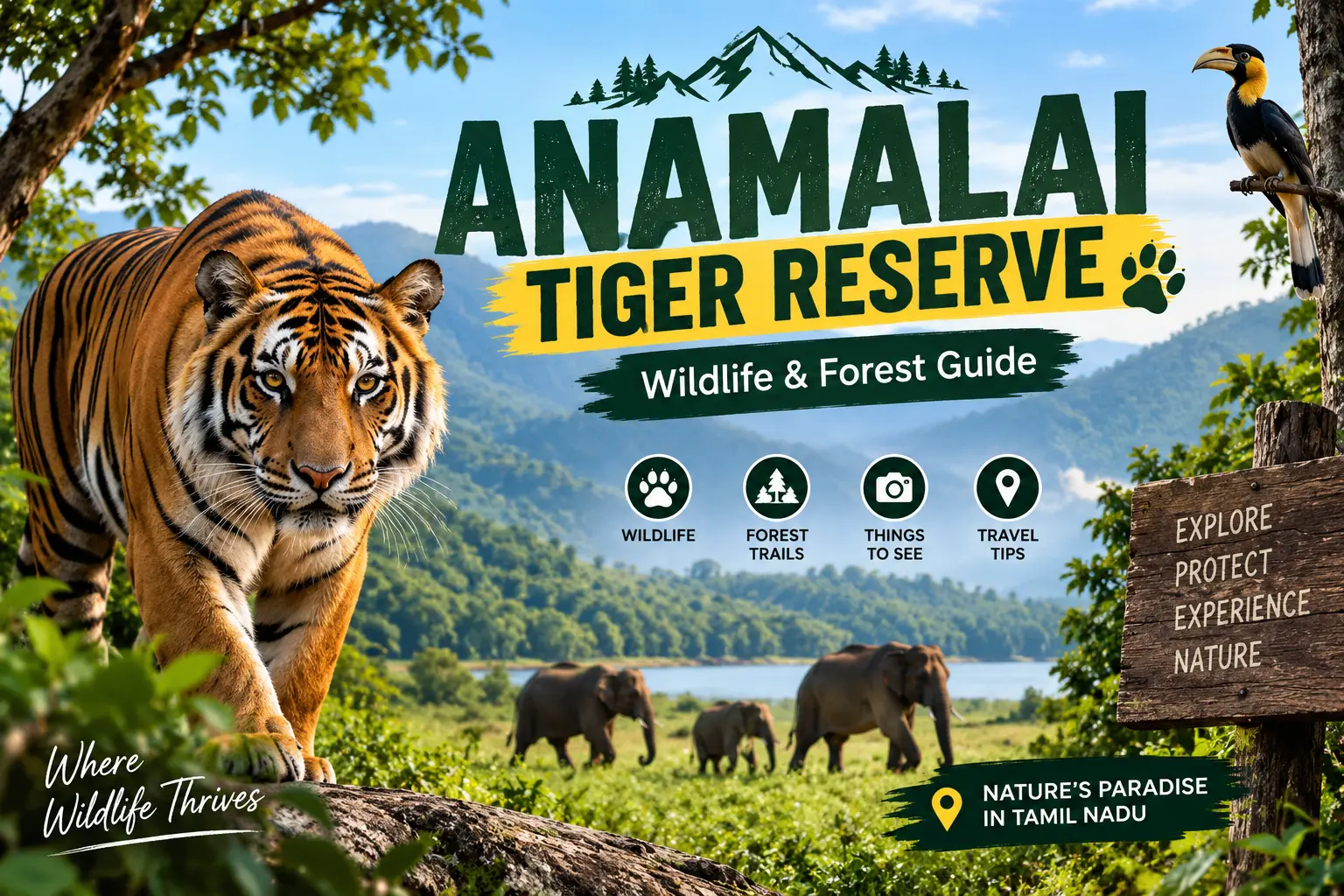
Anamalai Tiger Reserve: Wildlife & Forest Guide
Plan a trip to Anamalai Tiger Reserve in Tamil Nadu. Learn about its wildlife, forest types, best time to visit, key attractions and responsible travel tips.

Where the Western Ghats rise above the plains of Coimbatore and Tiruppur, the Anamalai Tiger Reserve protects some of South India's richest forest. It is also known as the Indira Gandhi Wildlife Sanctuary and National Park. It is less crowded than better-known reserves, which makes it a good choice if you like quiet forests, elephant country and birdsong more than checklist safaris.
About Anamalai Tiger Reserve
The reserve lies in the Anamalai (Anaimalai) hills of the southern Western Ghats, a region recognised as a global biodiversity hotspot. The name comes from the Tamil words for "elephant hills". Tamil Nadu notified it as a tiger reserve in 2007, and it adjoins Parambikulam Tiger Reserve, Chinnar Wildlife Sanctuary and Eravikulam National Park across the border in Kerala. Together they form a large, connected stretch of habitat that wide-ranging animals like elephants and tigers depend on.
According to the National Tiger Conservation Authority, the reserve has a core area of about 958.59 km² and a buffer area of about 521.28 km², a total of roughly 1,479.87 km². Elevation ranges from about 340 m to over 2,500 m. Pollachi is the usual base town.

Forest Types You'll Encounter
Elevation and rainfall change quickly here, so a short drive can take you through several kinds of forest:
- Tropical wet evergreen forests: dense, multi-layered and humid, with tall trees, epiphytes and ferns.
- Semi-evergreen and moist deciduous forests: a mix of evergreen and leaf-shedding trees that changes noticeably between seasons.
- Dry deciduous and thorn scrub: more open country on the drier side, good for spotting large mammals.
- Shola-grassland mosaics: at higher elevations, pockets of stunted evergreen forest sit within rolling grassland.
- Teak plantations: planted long ago and now part of the landscape, especially around Top Slip.

Wildlife Highlights
Mammals

- Asian elephants are the reserve's signature species, and herds are seen fairly regularly.
- Tigers and leopards live here, though tigers are elusive. A sighting is a bonus, not something to count on.
- Gaur (Indian bison), sambar, spotted deer (chital) and wild boar are common in open areas.
- Lion-tailed macaques, a rare and endangered primate found only in the Western Ghats, live in the evergreen forests.
- Nilgiri tahr, a mountain goat, lives on steep grassy slopes and cliffs at higher elevations.
- Nilgiri langurs, the Indian giant squirrel, sloth bears, dholes and smooth-coated otters are also recorded in the reserve.


Birds
The Anamalai region is a strong birding destination, with over 250 bird species recorded and most of the Western Ghats endemics represented. Look for the near-threatened great hornbill, along with barbets, drongos, flycatchers, woodpeckers, kingfishers and raptors such as hawk eagles.

Reptiles and amphibians
The forest floor and streams hold snakes, lizards, tortoises and many frogs, including several endemic species. Amphibian activity peaks during and after the monsoon.
Key Places to Visit
- Top Slip: the main tourist gateway, in a scenic teak and forest belt. The name comes from the 19th-century practice of sliding timber logs down the hills. It is the usual starting point for forest department vehicle safaris and nature walks.
- Aliyar and Amaravathi reservoirs: lakeside stops fed by rivers that rise in the sanctuary, good for views and birdwatching.
- Valparai plateau: tea and coffee estates surrounded by forest, with frequent wildlife sightings from the road. This area is a mix of estates and forest, not a formal safari zone.
- Waterfalls and viewpoints: pleasant stops depending on the season and access rules.

Best Time to Visit
- October to March: the most comfortable weather, with good conditions for forest drives and birdwatching.
- April to May: hot, but animals gather near water sources, so sightings can be good.
- June to September: the monsoon brings heavy rain, leeches and possible access restrictions, though the forest is at its greenest.
Conditions and access rules change, so check current status with the Tamil Nadu Forest Department before you finalise plans.
The People of the Forest
More than 4,600 Adivasi people from six indigenous communities, including the Kadar, Malasar and Muduvar, live in settlements within the reserve, and their knowledge of the landscape runs back generations. Where local guides are available, hiring them supports these communities and gives you a much richer understanding of the forest. Always treat settlements and traditions with respect, and ask before taking photographs of people.
Top Slip also hosts an annual Elephant Pongal celebration in January, where decorated elephants take part in the harvest festival.
Practical Tips for Visitors
- Book in advance. Safaris, entry permits and forest-department accommodation are managed by the Forest Department. Confirm timings, fees and availability beforehand.
- Travel with authorised guides. Trekking and nature walks generally need permission and an accompanying guide.
- Dress for the forest. Wear neutral or earth-toned clothes, closed shoes and, in the wetter months, leech socks. Bring insect repellent, a hat and a water bottle.
- Keep your distance from wildlife. Never feed animals, and stay in your vehicle where required. Elephants in particular can be dangerous.
- Carry binoculars. Much of the best wildlife watching, especially birds and canopy species, needs them.
- Leave no trace. Plastic and food waste harm wildlife. Carry out what you bring in.
- Keep noise down. Avoid loud music and shouting. The forest rewards patience and quiet.
Why Anamalai Matters
Anamalai is a habitat corridor, a watershed and a refuge for species found almost nowhere else. Rivers that rise here feed major reservoirs that support agriculture and power supply across Tamil Nadu. Protecting it takes forest staff, local communities and visitors who tread lightly. If you go, you help that effort by choosing responsible operators and respecting the rules.
Final Thoughts
Anamalai Tiger Reserve is worth a slower trip. Come for the elephants, stay for the hornbills, and leave with a better sense of how the Western Ghats fit together. Whether you spend a weekend at Top Slip or a few days exploring the wider region, the forest is at its best when you go in with patience and respect.
Image credits: all photos are hosted on Wikimedia Commons. Each caption links to the file page, where you can check the author and licence terms (many require attribution) before publishing.