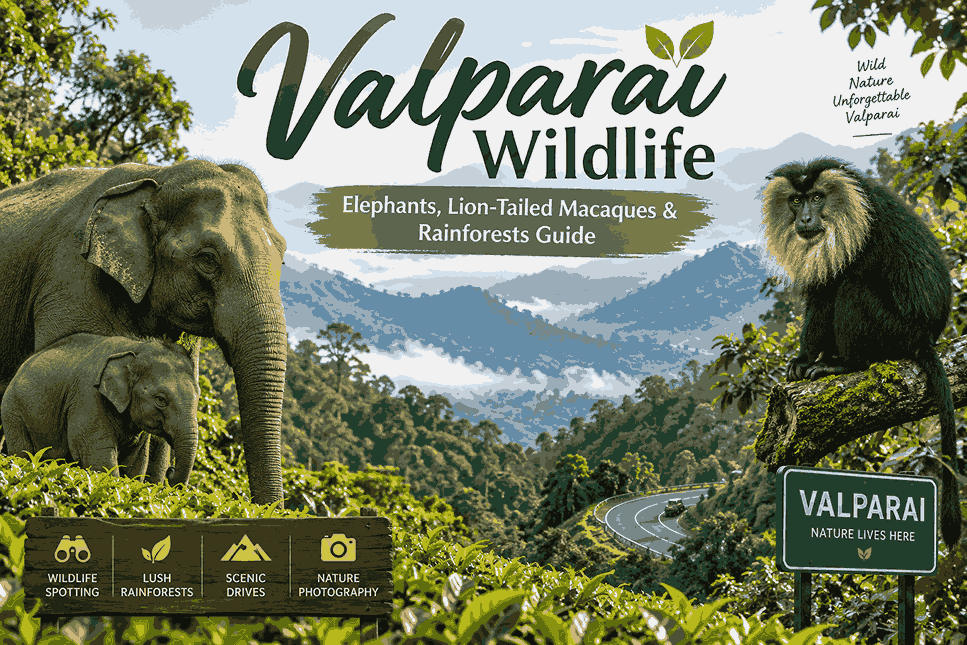
Most "wildlife guide" articles about Valparai list the same five animals and move on. This one goes deeper — because Valparai isn't just scenic, it's one of the most intensively studied human-wildlife landscapes in India. For over two decades, conservation scientists have tracked individual elephants by name, restored rainforest fragment by fragment, and built an early-warning system that has measurably cut human deaths from elephant encounters. That research is what makes this guide accurate — and it's also what makes Valparai worth visiting with your eyes open. If you're still deciding on the wider trip, this guide pairs well with our general Valparai travel guide covering routes, top places to visit and travel tips.
Why Valparai is Such a Wildlife Hotspot
Valparai sits at 3,474 feet (1,059 m) on the Anaimalai Hills — literally "Elephant Hills" in Tamil — part of the Western Ghats, a UNESCO World Heritage Site and one of the world's eight biodiversity "hottest hotspots." The Valparai plateau itself covers roughly 220 sq. km of tea, coffee, and cardamom plantations, but it's threaded through with rainforest fragments, ranging from tiny 10-hectare patches to a 2,600-hectare block, and ringed by the 1,479 sq. km Anamalai Tiger Reserve (formerly Indira Gandhi Wildlife Sanctuary). The Anamalai hills support the second-largest wild Asian elephant population in India — which is precisely why elephants, not tigers, are Valparai's real headline act.

Source: commons.wikimedia.org/wiki/Category:Anaimalai_Hills
Asian Elephants: The Real Story Behind the Sightings
Since 2002, researchers from the Nature Conservation Foundation (NCF), based at Iyerpadi just outside Valparai, have individually identified and tracked elephants moving through this landscape. Their database now includes close to 100 elephants across three to four regular herds, plus other peripheral groups — animals that follow the same seasonal routes their ancestors used before the forest was ever cleared for plantations. Movement peaks between September and April, tapering off during the heaviest monsoon months of May to August.
This isn't a "maybe you'll get lucky" destination the way many safari parks are — elephants are a near-constant presence on the plateau. But that also means Valparai is a genuine, documented human-elephant conflict zone, not just a photogenic backdrop. Historically, certain areas — like the Ryan tea division — accounted for a disproportionate share of human deaths from elephant encounters. In response, NCF and the Tamil Nadu Forest Department built a community early-warning system: SMS alerts, flashing indicator lights, and local awareness campaigns that flag elephant presence in real time.
The results are genuinely remarkable: annual human deaths from elephant encounters across roughly 350 villages in the region fell from an average of five per year (2010–2020) to about one per year (2020–2026). It's one of the more successful coexistence models in India's conservation record — and a reminder that the calm, elephant-dotted tea-garden postcards you'll see of Valparai exist because of deliberate, sustained work, not luck.

Source: commons.wikimedia.org/wiki/Category:Elephas_maximus_in_Anamalai_Tiger_Reserve
Where elephants are most often seen
- The Aliyar–Valparai ghat road, particularly in the cooler hours near dawn and dusk
- Riverine forest strips and rainforest fragments bordering tea estates — these fragments function as natural corridors linking larger forest blocks
- Estate roads near Iyerpadi and the plateau's interior, where herds cross between plantation divisions
- Near Sholayar and reservoir catchments, where herds often go to drink
Elephant safety — non-negotiable rules
- Never stop to photograph an elephant at close range — keep moving, or reverse to a safe distance
- Never exit your vehicle near an elephant, regardless of how calm it looks
- Ask your homestay or driver whether an early-warning alert is active before heading out at dusk
- Give herds with calves an especially wide berth — cow-calf groups are far more defensive
- If walking anywhere on the plateau at night, carry a light and stay alert — Valparai residents do not walk certain stretches after dark for good reason
Lion-Tailed Macaques: A Species Found Nowhere Else on Earth
The lion-tailed macaque (Macaca silenus) — sometimes called the wanderoo — is endemic to the Western Ghats and found nowhere else in the world. It's currently classified Endangered by the IUCN, and Valparai's forest fragments hold one of its most closely monitored populations anywhere in its range.
_at_Valparai_town.jpeg?width=900)
Source: commons.wikimedia.org/wiki/Category:Macaca_silenus
Identification
Black-furred with a striking silver-grey mane framing the face, lion-tailed macaques are named not for that mane but for their long, thin, tufted tail. They're on the smaller side for macaques — 2 to 10 kg — and are strongly arboreal, spending most of their time 30–50 metres up in the rainforest canopy, feeding on fruit from trees like Cullenia exarillata, a keystone rainforest species in the Western Ghats.
Where to look
- The Valparai–Pollachi road, where troops regularly cross — NCF field staff sometimes station themselves at known crossing points to warn traffic
- Rainforest fragments directly bordering Valparai town
- Forest patches near Sholayar and Iyerpadi
The feeding problem
Because certain troops have become accustomed to roadside human presence, well-meaning visitors sometimes feed them. This is genuinely harmful: it alters natural foraging behaviour, pulls animals toward roads (increasing collision risk), and can transmit disease between species. If you see a troop, watch quietly from a distance and never offer food — no matter how comfortable around people they appear.
The Rainforest Restoration Story Behind the Scenery
Much of what looks like "forest" around Valparai today is the product of active ecological restoration, not untouched wilderness. Beginning in the late 1800s, large expanses of rainforest were cleared for coffee and tea, leaving the fragmented patchwork you see now. Since the late 1990s, NCF scientists Divya Mudappa and T.R. Shankar Raman — who have lived and worked in Valparai for close to two decades — have run a rainforest restoration programme from a field station at Iyerpadi, raising native rainforest saplings in a nursery and replanting them into degraded patches, including old eucalyptus stands that were never actually rainforest to begin with.
The goal isn't just prettier forest — it's rebuilding functional wildlife corridors that let elephants, macaques, and other species move safely between larger forest blocks instead of being trapped in isolated fragments. It's a slow, decades-long project, planted monsoon by monsoon — and it's a large part of why Valparai's wildlife sightings remain as reliable as they are. Anyone interested in the bigger regional picture of forest cover, rivers and plant life across this range may also enjoy our broader look at the Western Ghats near Coimbatore.

Source: commons.wikimedia.org/wiki/Category:Anaimalai_Hills
Grass Hills: The High-Altitude Wildlife Frontier
Above the tea gardens, at elevations over 2,000 metres, lies Grass Hills — a montane shola-grassland plateau that forms the boundary between Anamalai Tiger Reserve and Kerala's Eravikulam National Park. This isn't your typical soft meadow grassland; it's a landscape of tough grass tussocks folded around dense, leech-infested shola forest pockets in the valley creases, with notable peaks like Attuparai Kurukku (6,662 ft). This high shola-grassland pattern repeats at several points along the range — the Palakkad Gap, for instance, is the closest major break in the same Western Ghats chain and worth understanding if the geography here interests you.
Grass Hills is the primary habitat of the Nilgiri tahr, an endangered mountain goat endemic to the Western Ghats' high-altitude grasslands, alongside elephants, gaur, lion-tailed macaques, and occasional big cats. It's a restricted area — visitors need permission from the Anamalai Tiger Reserve office (typically arranged via Pollachi or the Attakatti forest checkpoint), so this is a destination for wildlife enthusiasts willing to plan ahead rather than a casual stop. January to May is generally considered the best season to visit.
Other Wildlife of the Valparai Landscape
| Species | Where to Look | Notes |
|---|---|---|
| Indian gaur (bison) | Grasslands, tea estate edges, Grass Hills | World's largest wild cattle species; can be aggressive if disturbed, especially bulls in musth |
| Nilgiri langur | Rainforest canopy, often alongside lion-tailed macaques | Glossy black coat; frequently confused with the lion-tailed macaque at a distance |
| Nilgiri tahr | Grass Hills (permit required) | Endangered mountain goat endemic to Western Ghats grasslands |
| Great hornbill | Forest edges around Valparai and Topslip | Large-billed, unmistakable in flight; near-threatened |
| Leopard | Estate areas, mostly nocturnal | Elusive; occasionally preys on domestic animals near settlements |
| Tiger | Core zones of Anamalai Tiger Reserve | Rarely seen; monitored mainly via camera traps |
| Sloth bear, dhole (wild dog) | Deeper forest interior | Rarely encountered on casual visits |
| Sambar, spotted & barking deer | Forest edges, Topslip area | Commonly spotted on reserve drives |
Best Wildlife-Watching Spots Around Valparai
- Nallamudi Viewpoint — sweeping views over tea estates and forest, good for scanning distant slopes
- Aliyar–Valparai ghat road (the 40 hairpin bends) — reliable elephant and gaur sightings, especially early morning
- Valparai–Pollachi stretch near town — the most consistent lion-tailed macaque crossing zone
- Topslip — the main visitor hub of Anamalai Tiger Reserve, with guided treks and jungle safaris
- Sholayar and Nirar Dam areas — good for both scenery and elephant/deer sightings near water, and a short detour from some of the region's best waterfalls near Coimbatore
- Grass Hills — for Nilgiri tahr and high-altitude birding (permit required)
If you'd rather explore on foot, several of these routes overlap with trails covered in our roundup of best trekking spots near Coimbatore.
Visiting Anamalai Tiger Reserve: What to Know
- The reserve is generally open year-round; its ranges include Pollachi, Ulandy, Valparai, and Manamboli divisions
- Entry and safari timings, along with permit requirements, are set by the Tamil Nadu Forest Department and can change seasonally — always confirm current fees and slot availability locally before planning around them
- Both vehicle safaris and guided treks are typically available at Topslip
- Two-wheelers are usually restricted to specific daylight hours on forest roads
- Carry any required documentation, as officials have periodically requested health certification during specific health situations in the past
For a fuller breakdown of ranges, safari types and what to expect on arrival, see our dedicated Anamalai Tiger Reserve wildlife & forest guide.
Best Time to Visit for Wildlife
- September to April: Peak elephant movement across the plateau, per long-term NCF tracking data
- October to March: Cool, dry weather with the clearest overall visibility for general wildlife watching
- January to May: Best window for Grass Hills and Nilgiri tahr sightings
- Early morning and late afternoon: Elephants and gaur are most active near dawn and dusk
- Monsoon (June–September): Dramatic and lush, but elephant sightings on the open plateau drop, roads can be slippery, and forest access may be restricted at short notice
Getting There and Where to Stay
Valparai is reached via the dramatic 40-hairpin-bend ghat road from Aliyar, roughly a half-day drive from Coimbatore, making it a realistic option among the region's weekend getaways from Coimbatore. Since wildlife activity is concentrated at dawn and dusk, staying overnight on or near the plateau makes a real difference to what you'll see, rather than driving up and back in a single day.
Options range from jungle-facing stays such as Aara Jungle Resort to resorts on the Valparai plateau itself, including Ibex Resorts Valparai (Mistly) and Ibex Resorts Valparai (Tale Rock), or a base a little further out toward Pollachi at Ibex River Resort, Coco Lagoon by Great Mount or Coconest Eco Village. Whichever you choose, ask ahead about the current status of elephant-alert notices for that particular stretch of road.
Responsible Wildlife Viewing
- Never feed wild animals — elephants, macaques, and langurs alike
- Stay inside your vehicle around elephants; keep a genuinely safe distance, not just "far enough for a good photo"
- Skip flash photography and loud noise around wildlife
- Hire a local guide or naturalist where possible — they track current elephant movement patterns and will keep you out of avoidable danger
- Respect Forest Department permit and timing rules inside the reserve and at Grass Hills
- If you want to support the conservation work behind these sightings, NCF's Anamalai field programme (based at Iyerpadi) is a well-documented, long-running local initiative worth researching further
For more on the region's broader conservation efforts and how ordinary travellers can help, our piece on environmental awareness and the nature & environment section cover related ground.